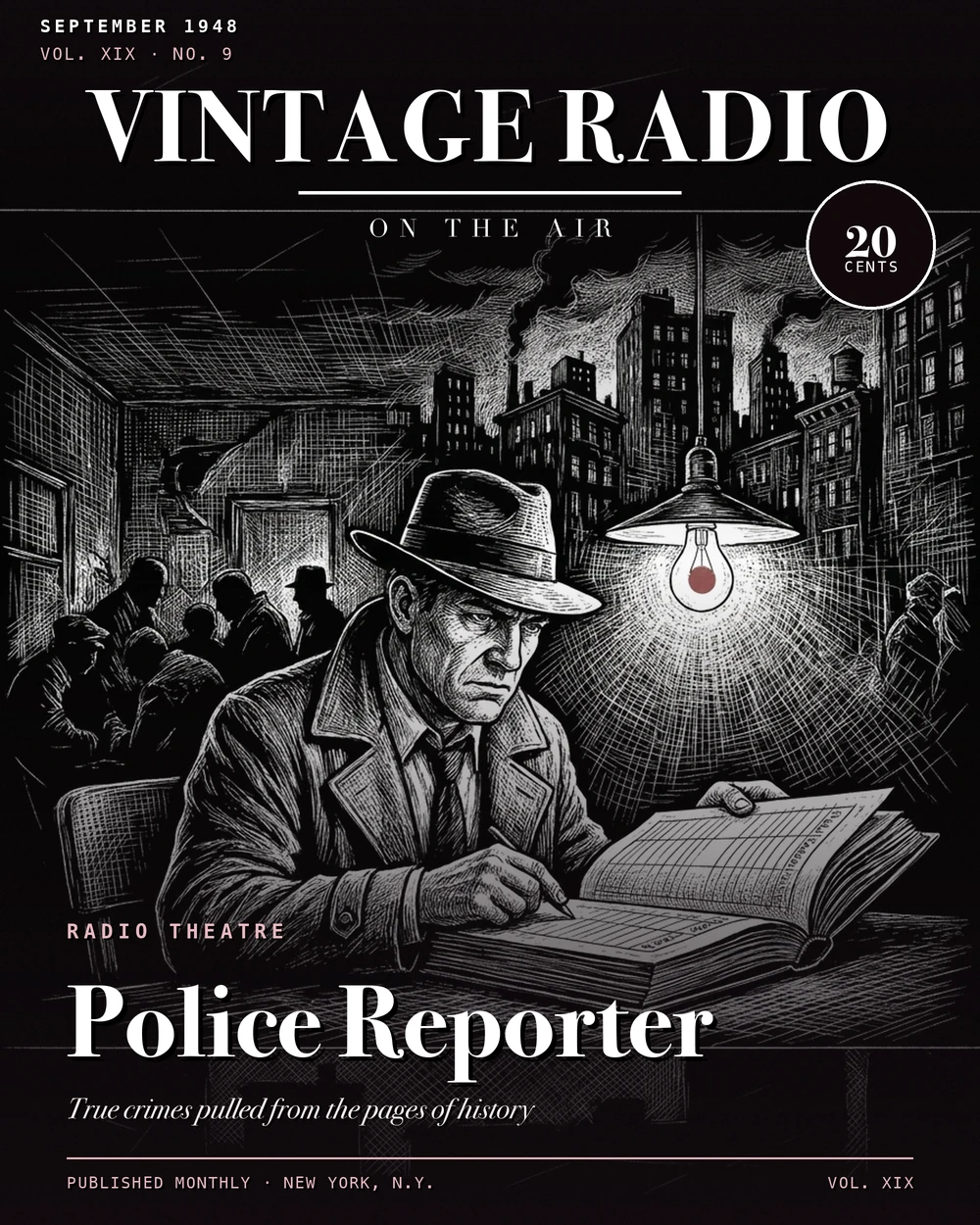
Police Reporter
Before Gangbusters, There Was This
The opening announcement of the first episode says it plainly: "This broadcast inaugurates a new radio series: true murder mysteries brought to you by The Police Reporter." That first episode dramatized a 1923 murder case out of Aurora, Illinois — and it went out over American radio somewhere around 1932, roughly two years before Gangbusters arrived on NBC as G-Men in July 1935. That timing matters. Police Reporter belongs to the earliest generation of true crime drama on American radio, a fifteen-minute syndicated series that established the format of ripped-from-the-headlines crime storytelling before most listeners had ever heard the genre.
The show was produced by Radio Release, Limited, a Hollywood transcribed-programming house. Transcription meant the episodes were recorded to disc and distributed to stations rather than going out live — which is precisely why the show could pop up on WEAF in New York on a Friday night in December 1933 and then turn up on KGPJ in Los Angeles the following February. It aired first across Southwestern stations in Arizona and California through 1935 and 1936, then worked its way into New Mexico and Texas. By 1936–1937, the World Broadcasting System out of New York had purchased or licensed the series under the WBS banner, pushing its reach further still.
What the Cases Actually Covered
The scope of material Police Reporter drew on is genuinely striking. The crimes it dramatized span more than 370 years of history — from a 1557 London case involving Lord Charles Stourton all the way up to a 1931 Ohio case about a convict named John "Red" Downing, who built the state's first electric chair and was then executed in it. That's not a typical range for a crime drama series. The producers were explicit about their willingness to go anywhere in history: they solicited scripts through The Writer's Market and invited story ideas from listeners, noting they'd consider cases reaching back as far as Elizabethan England and 1875 Paris, alongside contemporary headlines.
The episode titles give a sense of the variety. "The Burke and Hare Murders" reaches back to the infamous Edinburgh body-snatching case of the 1820s. "The Omelet That Cost a Man His Head (aka A Case Of Murder From Paris)" presumably draws from 19th-century France. "The Case Of The Mounties" lands in Canada. "The Case Of Texas Jim Baker" and "The Murder Of Tom Gorman" have a decidedly American feel. The series also used real names, real dates, and real locations throughout — which means the cases can be cross-referenced against actual historical records, a degree of specificity that adds a particular texture to the dramatizations.
Ordinary Cops, Overlooked Details
One of the more distinctive choices in Police Reporter is how it handles its police characters. The officers aren't sharp-eyed detectives with brilliant deductive powers. They're characterized, by the show's own apparent design, as ordinary beat cops — "flat-foot" officers doing workmanlike police business. What tends to unravel the murderer in most episodes isn't exceptional detective craft but a small overlooked detail: something the killer dismissed as insignificant that turns out to be decisive.
That's a different kind of dramatic logic than the genius detective story, and it gives the series a grittier, more procedural feeling. The show also made a point of spotlighting emerging forensic tools and investigative techniques of the early 1930s, which put it alongside Calling All Cars and early Gangbusters in what later commentators have placed in the "police procedural / sensationalist" bracket of pre-war crime radio. The sensationalism is real — episode titles like "A Gruesome Murder" and "Die with the Old Year" don't exactly underplay things — but the underlying storytelling logic leans on procedure and small-scale human error rather than melodrama.
The Cast and the Production Team
The principal cast members identified for the series include Noreen Gammill, C. Whitney Sheeley, Hugh Lester, Sid Bracey, Jack Lewis, Elizabeth Russell, and Blaire Davies. Beyond those names, detailed production credits for a syndicated transcription series from this period are sparse — typical for early 1930s programming that wasn't attached to a major network run from the start.
What is known about Radio Release, Limited places the company solidly in the transcribed-programming business of the era. The 1934 edition of The Writer's Market lists the producer, as does the 1935 edition of Broadcasting: Yearbook-Marketbook Issue. The script solicitation process through The Writer's Market was an active one — producers were taking pitches from freelance writers, which helps explain the breadth of historical material the series managed to cover. A sample episode dated to August 26, 1932 by catalog records suggests production was running by that summer, putting the show's origins at roughly the same moment that radio crime drama as a genre was just beginning to find its footing.
What Survives
All 26 episodes in circulation were digitized directly from a set of original transcription discs. The series was certified as Complete on January 11, 2011, meaning the 26 extant episodes represent all known surviving recordings from the run. For a syndicated transcription series produced between 1932 and 1934, that's a reasonably solid survival rate — transcription discs were fragile and often discarded once their broadcast usefulness was exhausted, and many early syndicated programs from this period exist only in fragments or not at all.
The surviving 26 cover a wide range — from the well-known Burke and Hare murders and the 1923 Aurora case that opened the series, to more obscure local crimes that would have faded from public memory within a decade of the broadcasts. The consistent use of real names and dates throughout makes the surviving episodes something of a documentary record of how early 1930s radio chose to frame and present criminal history to a mass audience — not sanitized, not fictionalized, but dramatized with the procedural texture of a newspaper crime beat.